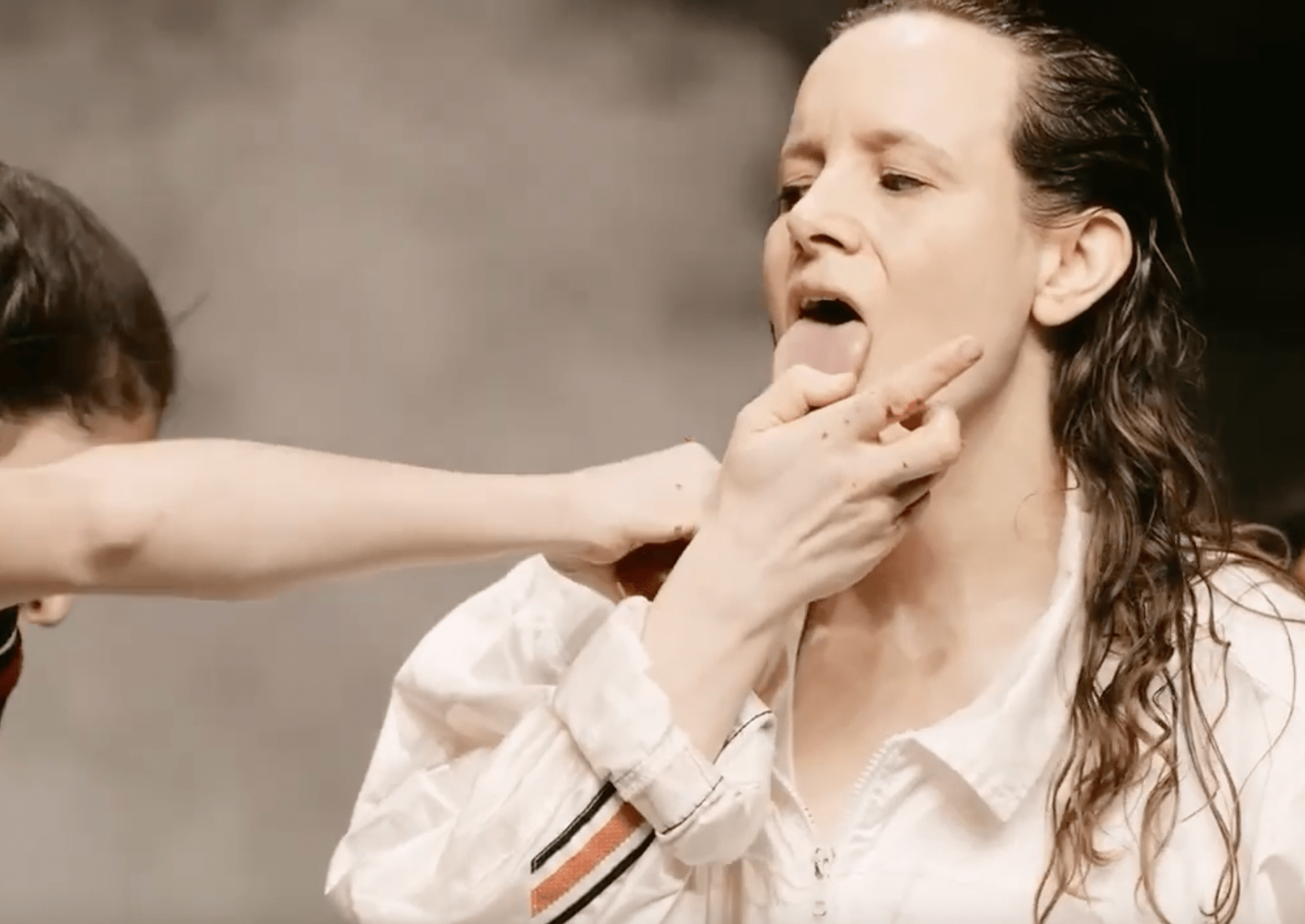
SKROVLIGA DANSER / CORASE DANCES is a dance solo created for and presented as a part of the exhibition “touching the touch: (im)material skins and haptic hallucinations” by Hara Alonso and Hiroko Tsuchimoto et al, in Folk i Skärholmens exhibitions space in the mall of Skärholmen.
The following text as well as the solo work Corse dances is a commission from artists Hara Alonso and Hiroko Tsuchimoto to respond to the artistic project touching the touch: (I’m)material skins and haptic hallucinations. Please read more about the exhibitions, publication and conecptual frame of the project and exhibitions in which the piece premiered further down.
COARSE DANCES by Ellen Söderhult (Swedish further down)
Ursula Le Guin once wrote an essay about the form of the narrative. She proposes a container, a carrier bag, as the first, essential cultural object instead of the spear. The container represents a form of storytelling that is not about conflict and conquest, but about gathering, holding, and preserving. She evokes an idea of a history of the everyday, of community and survival, full of tangents and connections rather than a straight path toward a resolution. A metaphor that, like a spacious, soft bag, makes room for other ways of valuing, experiencing, and describing.
The body is also a kind of container, constantly gathering impressions and creating memories. Bodies carry a metaphorical carrier bag of memories, emotions, and sensory impressions—both stored and acute. Through these, we listen with our senses. Listening to our surroundings and to the other, or to how our own flesh feels. The body’s largest organ, the skin, listens with its capacity to perceive pressure, temperature, texture… Perceiving through the sense of smell, which easily activates floods of memories since the olfactory system is directly linked to the parts of the brain responsible for emotion and memory. Through the sense of taste, which also, through repetition and exploration, has built a bank of associations, memories, and preferences.
In European intellectual history, the proximal senses of touch and taste are often linked to the body and the ephemeral; this caused them to be considered less reliable than the demarcating sense of sight, which historically has been viewed as the most objective. The eye throws itself like a spear, separating things from one another, but the hand and the tongue perhaps approach the actual reciprocity that conditions existence. When a warm hand holds an ice cube, they immediately begin to exchange temperatures. The water we drink is ancient and becomes part of our body through semipermeable cells before returning to the outside of the body. The air passes through our delicate, tiny alveoli and becomes part of vital processes in the body, through which the composition of our bodies is constantly changing.
But the eye also has a tongue, which functions much like the carrier bag theory. As children, we lick, bite, and taste everything around us—impressions that are stored and, through the overlapping ways the senses operate, provide us with skilled eye-tongues. That aspect of vision attends to roughness, temperatures, textures, just like how sounds moving into our ears blend with one another but also with information from the skin’s vast sensory organ and its memories. The touch of the wind, how raindrops land on leaves, on a metal balcony railing, and on the warmer surface of the body.
Dancing, and watching dance, can be a bit like activating the listening aspect of all the senses, allowing them to blend with the carrier bag of sensory memories and associations that the body carries. Dancing can be to listen with one’s whole flesh and in relation to one’s carrier bag of memories. Paying attention to the body’s relationship to its surroundings, similarities to past experiences and the lived experience of others, listening to one’s own mucous membranes and skeletal parts, to tendons taut as violin strings, and to the textures of sound. A dance that asks to be viewed like a sunset or a tree: with nothing to say, but full of intensities. An undramatic carrier-bag dance that embodies what is felt.
ABOUT THE PROJECT
touching the touch: (im)material skins and haptic hallucinations is an artistic exploration centred on touch as a form of listening and the interplay between sensation and matter. Through a multidisciplinary prism, the project unfolds multiple sensory modalities: the haptic vision, the flesh touch and the tactile ear into artistic practice. This study delves into touch as a primary sense of nearness, intimacy and reciprocity, to cultivate an augmented perceptibility to the vibrational essence of the world.
This project was initiated by the musician Hara Alonso in collaboration with the artist Hiroko Tsuchimoto and joined by the choreographer Ellen Söderhult, the musicians Vilhelm Bromander and Ryan Packard and the graphic designer Sissela Blanco. Muchas gracias to the contributors, Lucía Hinojosa Gaxiola and Alba Pagán for their beautiful poems. Special thanks to Folk i Skärholmen for hosting the project and specially to Izabella Borzecka for the curation and support.
Together with the exhibition Hara Alonso & Hiroko Tsuchimoto edited a publication in collaboration with Ellen Söderhult, Alba Pagán and Lucia Hinojosa Gaxiola., with graphic design by Sissela Blanco.
As a part of the exhibition there we workshops by Hara Alonso and Hiroko Tsuchimoto and dance performances free for all starting in the exhibition space and moving out into the mall.
När huden lyssnar: (im)materiella skinn och hörbar beröring
Välkommen till en utställning som utforskar känseln som ett sätt att lyssna och uppleva sin omgivning. Genom material som textilier och vibrerande ljudlandskap väcks olika sinnen till liv – vi ser med händerna, hör med huden och känner med hela kroppen.
Hur kan ett material bära på minnen och berätta en historia? Här får du komma nära och upptäcka ett intimt möte mellan dig, ljud och material – och känna världens vibrerande essens.
Utställningen är en del av ett konstnärligt projekt som utvecklats under våren 2025 på FOLK i Skärholmen av musikern Hara Alonso, i samarbete med konstnären Hiroko Tsuchimoto och tillsammans med koreografen Ellen Söderhult, musikerna Vilhelm Bromander och Ryan Packard samt grafiska designern Sissela Blanco.
Under utställningen hålls tre workshops med Hiroko Tsuchimoto och Hara Alonso, samt fyra dansföreställningar av Ellen Söderhult, öppna för alla. Mer information om dessa finns på vår hemsida!
Vernissage: onsdag 24 september kl. 17.00–19.00
Utställningsperiod: 24 september – 19 oktober
Öppettider: onsdag–söndag kl. 12–16
“SKROVLIGA DANSER”:
På vernissagen, onsdag 24/9 någon gång mellan 17 och 19
27 september kl. 15.00-15.15
11 oktober kl. 15.00-15.15
Samt på finissagen 18 oktober kl. 15.00-15.15
Adress: SKHLM Konsthall, Storholmsgatan 16 (mittemot Myrorna)
–
Programmet i SKHLM Konsthall genomförs med stöd av Kulturrådet, Stockholms stad och i samarbete med SKHLM Centrum. Vernissage i samarbete med ABF Stockholm.
15e maj 2026: Hara Alonso and Martin Sieweke: LEAKING INTO PARA-TIME, with special guest Ellen Söderhult (SKROVLIGA DANSER /COARSE DANCES, variations) at FYLKINGEN, Bredäng. DJ Jean-Paul Tremont. Tickets 120/80. More info here.
OM SKROVLIGA DANSER
Ursula LeGuin skrev en gång en essä om berättelsens form. Hon föreslår en behållare, en bärpåse som det första, viktiga kulturella föremålet istället för spjutet. Behållaren representerar en berättarform som inte handlar om konflikt och erövring, utan om att samla, hålla och bevara. Hon skriver fram en idé om historien om det vardagliga, om gemenskap och överlevnad, full av sidospår och kopplingar snarare än en rak väg mot en upplösning. En metafor som likt en rymlig, mjuk påse gör plats för andra sätt att värdera, uppleva och beskriva.
Kroppen är också en slags behållare, som hela tiden samlar på sig intryck och skapar minnen. Kroppar bär på en metaforisk bärpåse av minnen, känslor och sinnesintryck, lagrade och akuta. Genom dessa lyssnar vi med sinnena. Lyssnar till omgivningen och den andra eller till hur det egna köttet känns. Kroppens största organ huden lyssnar med sina förmågor att förnimma tryck, temperatur, konsistens… Förnimmer med doftsinnet som lätt aktiverar floder av minnen, eftersom luktsystemet är direkt kopplat till de delar av hjärnan som är ansvariga för känslor och minne. Genom smaksinnet, som även det genom upprepning och utforskning, byggt en bank av associationer, minnen och preferenser.
De nära sinnena beröring och smak kopplas ofta i en europeisk idéhistoria till kroppen och det förgängliga; vilket gjorde att de ansågs mindre pålitliga än blickens avgränsande sinne som historiskt sett som det mest objektiva. Ögat slänger sig som ett spjut och avgränsar ting från varandra, men handen och tungan kanske närmar sig den faktiska ömsesidigheten som villkorar existensen. När en varm hand håller en isbit börjar de med en gång utbyta temperaturer. Vattnet vi dricker är uråldrigt och blir en del av vår kropp genom semipermeabla celler innan det återgår till att vara utanför kroppen. Luften passerar genom våra skira små lungblåsor och blir del av livsviktiga processer i kroppen genom vilka våra kroppars sammansättning hela tiden förändras.
Men ögat har också en tunga, som fungerar mycket likt bärkasse-teorin. Som barn slickar, bitar, smakar vi på allt omkring oss, intryck som lagras och i sinnenas överlappande sätt att fungera förser oss med skickliga ögon-tungor. Den blicken tar in skrovligheter, temperaturer, konsistenser, på samma sätt som ljud som rör sig in i våra öron blandas med varandra och information från hudens stora känselorgan. Vindens beröring, hur regndroppar landar i löven, på ett balkongräcke av metall och på kroppens varmare yta.
Att dansa och att betrakta dans kan vara lite som att aktivera den lyssnande aspekten av alla sinnena och låta dessa blandas med den bärkasse av förnimmelse-minnen och associationer som kroppen bär på. Dansa kan vara att lyssna med hela sitt kött och i relation till sin bärkasse av minnen. Att uppmärksamma kroppens relation till omgivningen, likheter med tidigare upplevelser och andras levda erfarenhet, lyssna till de egna slemhinnorna och skelletdelarna, till senor spända som fiolsträngar och till ljudets konsistenser. En dans som ber om att få betraktas som en solnedgång eller ett träd: utan något att säga men full av intensiteter. En odramatisk bärkassedans som gestaltar det som känns.

